



insights

Many organisations work with data silos, running systems in isolation, or clinging to legacy technology that resists integration. The truth is stark: isolation is the enemy of innovation.

Despite the promise of AI, many organisations are also finding themselves unable to unlock its full potential due to the speed to access their siloed data and its quality.

1. The Genesis: Navigating the Landscape of Traditional Batch Processing
This article is reproduced in entirety with permission from Confluent, of which Sida4 / 4impact is a proud APAC Integration Partner.

Have you ever wondered why today’s systems are not quite coping – and being perplexed with what’s actually happening in today’s environment. Certainly, this lack of ‘coping’ is something that we have had a lot of conversation with clients about, particularly over the last 12 months, and for us, what’s coming to the fore is the need for scaled response. Scaled response because the geographies impacted by complex businesses are becoming so much greater. We’re getting scaled weather events that require a much bigger response by government, by not for profits, by all sort of organizations. Social media means that you need a scaled response to a much larger customer base when events happen – or to be able to respond to customer needs such as large scale of data breach and the like. Even when you think about when systems are impacted in some way shape or perform, it’s a much larger impact because you have so many more customers on the end of those systems or their open systems and there’s knock-on effects and unattended consequences when we change things. So, at all levels, we need a much bigger capability than some of their current brittle analog to digital base processes that allow for the scale of what happens today. Data is really events, so many events, events at mass scale. When you start to use your data in terms of your data being an event, it starts to change the way that you manage your business. It enables real-time user experiences, so instead of batch base processes and highly connected systems that require maintenance and point-to-point interfacing, we need scaled responses that are real-time when your data is seen as an event and everything that is connected to that event is updated at the same time. So, mass user experiences get enhanced in a way that they need at once. Having data in an event format enables real-time decisioning to be done as opposed to waiting for all the knock-on systems to be able to make/bring together that information over time. So coupled with data at the center is the ability to then to apply your artificial intelligence, your machine learning to those data environments and those events - that’s what gives you a scale response capability. So why is scaled response important? Scaled response is massively important when significant large geographic issues occur, or when mass events occur in terms of data breaches, when you are launching a brand-new product. "For example, if you are a bank or an insurer to your customer base, you need the ability to able to respond in seconds, in hours – not weeks, not months." You need to be able to respond in a system base way rather than relying on the ability to bring on people capacity, because that is very hard in the current environment with the war for talent. You want scaled response because you want to be able to manage your brand better and not have the negative impact and loss of customers if you don’t do it well in this current environment. By creating a scaled response capability from unlocking your data also means that you less likely to have that failure to launch, so when you are introducing your new product, you want be able to get that product to as many people as quickly as possible. That doesn’t happen if you’re too constrained by how your systems connect and how far they can actually reach. Your ability to avoid failures, to react, to protect, to respond and support your customer-base is absolutely critical because the ability to switch within a scaled response environment is much easier. At Sida4 we believe that the important work for many complex organisations today, is help them to create scaled response environments, and at the center of that is unlocking their data and enabling it to be event-driven. If you’d like to talk more about our data transformation services that can help you create a scaled response environment, just reach out for a chat .

This article is reproduced in entirety with permission from Confluent, of which Sida4 / 4impact is a proud APAC Integration Partner. Original author Adam Bellemare.

A golden record (aka single view/complete view) is a term used in the field of data management and refers to a single, authoritative, and accurate representation of a data subject, such as a customer or an employee, that is derived from various sources and maintained in a centralised repository. At a very basic level, you can think of a golden record being a little like a jigsaw puzzle, all pieces are required to see the full picture, or the 'Single view'. However for complex businesses, all of the pieces aren't generally in the same box, same shelf, and some pieces are completely missing, or damaged. Golden records are important because they provide a single source of truth for organisations, which can improve data quality, increase operational efficiency and help prevent errors and inconsistencies across various systems. They also play a critical role in data governance and master data management initiatives, which are necessary for effective decision-making, regulatory compliance, and improved customer experiences. The process of creating a golden record typically involves the following stages: Data Collection: Gathering data from various sources, such as internal systems, external databases, and manual inputs, to create a comprehensive view of the data subject. Data Cleaning and Standardisation: Removing duplicates, correcting errors, and standardizing the data to ensure that it is consistent and accurate. Data Matching and De-duplication: Identifying and merging duplicates and conflicting information to create a single, authoritative representation of the data subject. Data Enrichment: Adding missing or supplementary information to the golden record to make it more complete and useful. Data Validation: Checking the accuracy of the golden record and ensuring that it complies with business rules and data quality standards. Data Maintenance: Regularly updating and maintaining the golden record to keep it accurate and up-to-date. Data Access and Distribution: Providing secure and controlled access to the golden record for authorised users and systems. This process generally requires the use of specialised software and techniques, such as data governance tools, data quality solutions, and master data management platforms. It may also involve collaboration between various teams and departments, such as IT, data management, and business operations. The value of a Golden Record across Retail, Healthcare/NDIS, and Tertiary Education Golden Record for Retailers With a single view of the customer, retailers can access all the relevant data in real-time, empowering them to make informed decisions and take action quickly. This leads to: Faster and more effective marketing and customer service experiences. Improved back office processes to reduce errors, save time, and lower costs. Additionally, having a centralised customer view eliminates the need for manual reporting, freeing up IT resources and allowing retailers to act on insights and make data-driven decisions more quickly. Golden Record for Healthcare and NDIS service providers A Golden Record for healthcare providers refers to a single, accurate and up-to-date version of a patient's information, such as their medical history, demographics, treatment details and support needs, that is accessible to all authorised providers across different healthcare organisations. This information is critical to ensuring quality patient care and reducing errors, as it provides a comprehensive view of a patient's health history and current treatment. Having a ‘Single view’ can help: Improve patient outcomes Faster decisioning for ongoing support needs Reduce duplicative tests and procedures and increase efficiency in the healthcare providers organisation. Golden Record for Tertiary education and universities In the context of tertiary education and universities, a Golden Record can provide significant value by providing a centralised and comprehensive view of each student's educational history, including their personal information, enrollment data, grades, and other academic information. This information can help to: Streamline administrative processes. Connect and correct data across disparate or siloed systems to ensure data accuracy and consistency. Improve decision-making for various stakeholders such as faculty, staff, and students. Improve the ability of universities to track student outcomes. Comply with regulatory requirements. and make data-driven decisions that can improve the overall quality of education. Ultimately, all Data projects should be driven by the need to deliver data trust. Achieving data trust is a key competitive advantage, and that confidence comes from having access to trusted information and insight when you need it. This means ensuring that data is accurate, consistent, and reliable, and that it is used in a responsible and ethical manner. Achieving data trust requires a combination of technical solutions, such as data governance and quality tools, and effective data management processes and policies, such as data privacy and security measures. To do that requires and in-depth understanding of your current state, goals and challenges so we can move towards recommended solution paths with a phased delivery approach. When data is trustworthy, organisations can make better decisions, improve customer experiences, and operate more efficiently, which ultimately leads to better outcomes and business success. Igniting your business potential relies on achieving data trust, and that can start with a simple conversation .

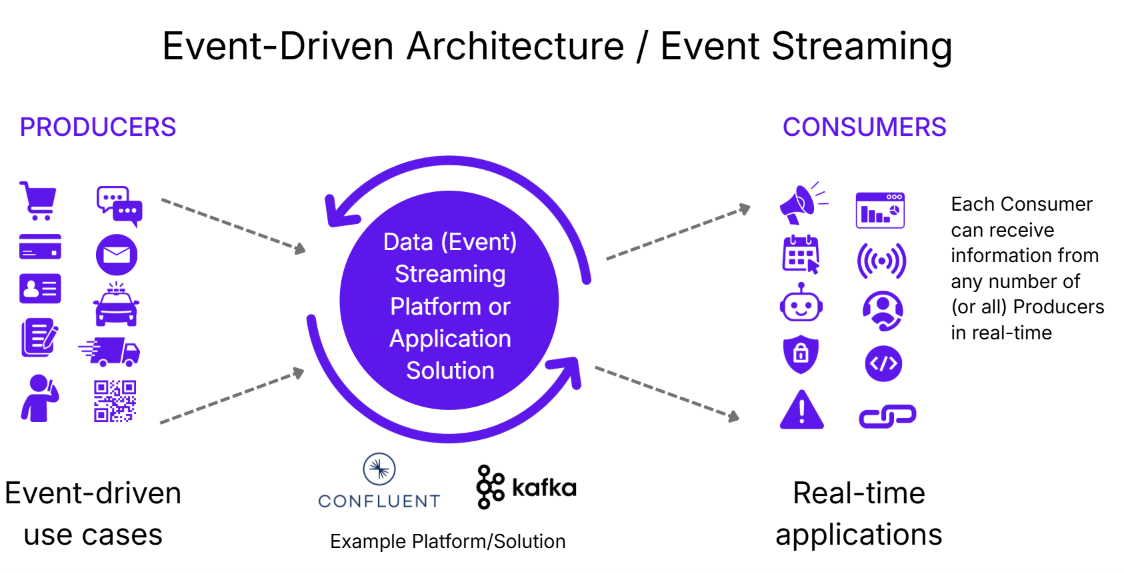
Data streaming is the continuous flow of data that is generated by various sources and processed in real-time. This data can come from a variety of sources, including databases, sensors, user activity, and social media. Data streaming enables organisations to process and analyse large amounts of data as it is being generated, rather than waiting for the data to be stored and processed in batch mode. This allows organisations to gain real-time insights into the data and make informed decisions based on the most up-to-date information. Examples of data streaming applications include enterprise integration, real-time analytics, fraud detection, IoT device management, and log management. "Businesses move at a faster pace than ever before. And accessing data in real-time is a critical component of delivering a competitive advantage strategy." Data streaming is the recognised approach for solving the latency-of-access challenges inherent with traditional, on-prem or stale-data systems. Stale-data systems refer to systems or processes that rely on outdated or obsolete information. These systems are no longer fit for purpose because they can lead to inaccurate decision-making and cause various problems for businesses and organisations. In today's fast-paced and constantly changing world, relying on stale data can lead to missed opportunities and increased risk. For example, if a financial institution relies on outdated data to make investment decisions, they could make poor investments that lead to financial losses. Similarly, if a healthcare provider relies on stale patient data, they could make incorrect diagnoses or prescribe inappropriate treatments. Moreover, stale-data systems can also lead to compliance and legal issues. For instance, if an organisation fails to update its records regularly, it may be in violation of data protection laws and regulations. To stay competitive and operate effectively in today's data-driven world, businesses and organisations must ensure that their systems and processes are built on current and accurate data. This means implementing robust data management and governance practices, push data sources, and utilising advanced analytics and machine learning technologies to analyse and interpret data in real-time. By doing so, they can make informed decisions, reduce risk, and stay ahead of the curve in their respective industries.

The banking industry is undergoing a significant transformation due to advancements in technology, changing consumer expectations, and evolving regulatory requirements. The risks of inaction in customer-owned banks (mutuals) are similar to those of traditional banks, but there are some unique risks to this model as well. A major risk is losing member trust and therefore ‘customer lifetime value’ is at risk. In parallel, falling behind in technology, limited product offerings, regulatory non-compliance, and member retention all are high-risk components of a lack of focus and transformation activities. Customer-owned banks must be proactive in meeting member needs, embracing technology, and complying with regulations to remain competitive and relevant. Banking institutions can benefit greatly from prioritising data management as a foundational step in their transformation journey. So to avoid the risks of inaction, where is the best place to start with a banking transformation? The best place to start any banking transformation is to start with solving data management first. Solving data management first is critical for customer-owned banks to make better decisions, offer personalised service, enhance efficiency, mitigate risks, and increase revenue. "Customer-owned banks must prioritise data management as a foundational step in their transformation journey and invest in the technology and staff training needed to achieve success." Identify the data needed: Customer-owned banks should identify the types of data needed to make better decisions, improve service, and manage risks. Establish data governance: Customer-owned banks should establish data governance policies and procedures to ensure data quality, consistency, and security. Invest in technology: Customer-owned banks should invest in technology that can capture, store, and analyse data effectively. This includes data warehouses, business intelligence tools, and data analytics platforms. Train staff: Customer-owned banks should train staff on data management best practices and how to use data analytics tools effectively. Monitor and measure: Customer-owned banks should regularly monitor and measure the effectiveness of their data management systems to identify areas for improvement and ensure ongoing success. One of the most common data challenges for banking transformation is the ability to achieve a single view of customer. A single view of the customer ( Golden Record ) is a comprehensive, 360-degree view of each customer's interactions with a bank across all channels and touchpoints. It includes data on a customer's preferences, behaviours, transactions, and other relevant information. Having a single view of the customer is critical for customer-owned banks, and is one of the highest business stability and growth limiters from the risk of inaction. Achieving a trusted single view of customer or golden record will: Enhanced customer experience: With a single view of the customer, customer-owned banks can offer personalised service and tailored products and services that meet the unique needs and preferences of each customer. This can enhance the overall customer experience and build loyalty and trust. Improved cross-selling and upselling: A single view of the customer enables customer-owned banks to identify cross-selling and upselling opportunities based on a customer's behaviour and preferences. This can help banks generate more revenue and increase customer lifetime value. Better risk management: A single view of the customer enables customer-owned banks to better assess the risk associated with each customer, such as credit risk, operational risk, and compliance risk. This can help banks mitigate risk and reduce losses. Increased efficiency: A single view of the customer can help customer-owned banks streamline their operations and reduce costs by eliminating duplicate data entry, automating processes, and improving decision-making. Regulatory compliance: Customer-owned banks are subject to the same regulatory requirements as traditional banks. A single view of the customer can help banks comply with regulations, such as anti-money laundering (AML) and Know Your Customer (KYC) requirements. Igniting your inner digital bank relies on achieving data trust, and a confident single view of customer across your systems. Reach out for a chat and together we can start unleashing your inner digital bank, starting with accessing trusted data.

Publishing note: This article was originally published under the 4impact brand and is now represented by Sida4, their data enablement and integration focused sister company.

The decision to implement a data warehouse is a pivotal one, impacting multiple facets of your organisation. Being mindful of the signs and considerations outlined here will help you make an informed, timely decision. Remember, in the modern business ecosystem, the adage "knowledge is power" has evolved to "data-driven knowledge is power." "Choose wisely, and you'll empower your organisation to scale new heights." This often leaves decision-makers pondering a significant question: When is the right time to consider implementing a data warehouse? The Signs You're Ready Data Volume and Complexity A key indicator that you need a data warehouse is the sheer volume and complexity of data you're handling. If you find that your existing data storage solutions are struggling to keep up with the rate of data accumulation, that's a sign. Disparate or Siloed Data Sources If you’re grappling with data from various sources and in diverse formats, a data warehouse can bring much-needed coherence. Performance Issues Another clear sign is when frequent queries to your operational databases affect the performance of other critical systems. Transactional databases are optimised for operations, not analytics. A data warehouse takes the analytical load off your operational systems, thus preserving their efficiency. Inadequate Data Access If your team spends excessive time tracking down data across disparate systems, it's not only inefficient but also prone to error. A data warehouse offers a consolidated view, making it easier to access and manage data. Requirement for Advanced Analytics As businesses mature, so do their analytics requirements. Advanced analytics, data mining, and predictive modelling are far easier to perform with a data warehouse. If you're increasingly needing these capabilities, it's time to consider investing. Evaluating the Timing Budget Considerations Data warehousing is an investment. The good news is that cloud-based solutions have made data warehousing more affordable than ever. However, you still need to ensure that the ROI makes sense for your organisation. Team Readiness A data warehouse is only as good as the team running it. Consider whether your staff has the necessary skills or if you'll need to provide training or hire additional talent. Business Scalability If you're a small startup with straightforward data needs, rushing into a data warehouse might be overkill. Conversely, if your business is scaling rapidly, waiting too long could make the eventual transition more cumbersome. Strategic Alignment Your data strategy should align with your business strategy. If your organisation is aiming for aggressive growth, mergers, or diversification, having a robust data warehouse will provide the insights needed to make informed decisions. 5 steps to Take Before Implementation Stakeholder Buy-In: Secure commitment from the key decision-makers within the organisation. Needs Assessment: Conduct a thorough review of your current data management system, team capabilities, and business requirements. Vendor Selection: Choose a data warehouse solution that aligns with your organisational needs. For example, Cloud-based solutions like AWS Redshift, Google BigQuery, Databricks, Snowflake might be good options. It is important to do your homework to get a 'right-fit' and scalable solution. Pilot Testing: Before going all in, run a pilot project to ensure the system meets your analytics, performance, and scalability requirements. Training and Transition: Finally, train your team on the new system and prepare for the transition, keeping in mind that there will be a learning curve. Should I include a Logical Architecture review as part of the process? The logical architecture should be considered during the planning phase, right after securing stakeholder buy-in and conducting a needs assessment. Having a well-thought-out logical architecture is not just an option but a necessity for a successful data warehousing project. It adds structure to the chaos, aligns your team, and provides a roadmap for effective data management and analytics. Make sure it's part of your data warehousing journey from the outset. It should be revised and potentially updated during the following scenarios: System Upgrades: Whenever the data warehouse system undergoes an upgrade, review the logical architecture to ensure it still meets the business needs. Business Scalability: If the organisation scales or diversifies, you might need to revisit and adjust the architecture to cater to new data requirements. Data Source Changes: When integrating new data sources or retiring old ones, the logical architecture may need a review to ensure continued cohesiveness and performance. Regulatory Changes: Compliance with legal requirements can necessitate updates to your data governance policies, which in turn may require changes to the logical architecture. Performance Review: Periodic system performance reviews can reveal bottlenecks or inefficiencies that may be addressed by altering the logical architecture. Sida4 provides Data Warehousing and Logical Architecture review services for a wide range of complex businesses. Defining when and how to move forward often requires a little help. Our teams of experts have cross-industry experience to identify the best (phased) ROI-focused approaches and make recommendations that make sense to your specific business environments and operational goals. Exploring which Data Warehousing approach would be best for your organisation all starts with a simple chat .

Business is increasingly becoming more complex, which is why technology transformation projects often encounter unprecedented challenges. More often than not most significant projects can involve multiple legacy systems, disparate data sources and formats, and 'capability and capacity' gaps. The need to mitigate risk in these environments is crucial, however that is not a simple task. Project delays, technical stall, scope change/creep and unforeseen roadblocks can become all too common. While it's natural for projects to face challenges, what defines a team's capability is their aptitude for recovery. With robust strategies, a proactive approach, and the right expertise at hand, even the most wayward projects can be navigated back to green. "Project recovery teams are generally engaged by organisations when a previous vendor(s) has failed to deliver. Wayward projects go late one day at a time, and by ignoring 'why', those days and their issues compound until it's recognised as a 'cease and save'." But why do projects generally go off track, and more importantly, how can they be rectified? Let's start with why Projects can't go wayward Projects without clear objectives tend to drift aimlessly, leading to wasted resources and confusion. When planning is insufficient, tasks become chaotic, breeding inefficiencies. Scope creep, or the unanticipated growth of project aims, places undue stress on resources, resulting in delays. Poor communication often culminates in misaligned ambitions and missed targets. Without the requisite skills or assets, a project's advancement may falter. Outside forces, such as regulatory changes or global events, have the power to unexpectedly derail a project's trajectory. Unclear Objectives: A project without a clear and well-defined objective is akin to a ship sailing without a compass. The absence of concrete goals can lead to confusion, misdirection, and wasted resources. Inadequate Planning: Every project requires a detailed plan, outlining the steps, resources, timelines, and potential challenges. In its absence, tasks can become muddled, leading to inefficiencies. Scope Creep: Expanding a project’s scope without proper time, budget, or resource adjustments can lead to overexertion and inevitable delays. Ineffective Communication: Poor communication can result in misalignment, missed deadlines, and mismatched expectations. Inadequate Skills and Resources: Capability and capacity gaps present from not having the right mix of skills or underestimating resource requirements can seriously hamper a project's progress. External Factors: Sometimes, external factors such as regulatory changes, market shifts, or global events can disrupt a project's trajectory. Strategies to bring Projects back to green Harnessing a project's potential and planning the recovery begins with defining clear objectives; have they changed or are they still relevant? A scope review generally forms part of the success steps, and once confirmed or adjusted and committed, will enable all the moving parts for a recovery to be realigned. External factors like regulatory changes or global events can influence the journey, being adaptive can turn these challenges into opportunities, truly unleashing a project's potential. Project Health Assessment: Start by assessing the current state of the project. Identify the gaps, issues, and areas of concern. Generally this requires external engagement, not an internal approach. Reset Objectives: Refine and redefine the project objectives to ensure they're clear and achievable. Realigning with core business objectives can also help prioritise tasks. Effective Communication: Foster open channels of communication. Regular status updates, feedback loops, and alignment meetings can ensure everyone is on the same page. Scope Management: Reassess the project scope. If necessary, descope certain elements or reallocate resources to ensure that the main objectives are met. Resource Augmentation: Sometimes, projects may require additional hands or specific skill sets on deck. Consider technology contractor staffing, consultant placement, or temporary staffing solutions to bolster your team. Implement Risk Management: Identify potential risks and create mitigation plans. Having a proactive approach can help in averting future pitfalls. External Expertise: Sometimes, an external perspective can provide invaluable insights. Consider bringing in consultants specialising in areas like master data management, data migration, logical architecture or app architecture review or financial system integrations to offer expert advice and course correction. Stakeholder Management: Ensure that stakeholders are informed, engaged, and aligned with the project's revised direction. Their buy-in is crucial for smooth execution. Defining when and how to move forward often requires a little help. While it's natural for projects to face challenges, recovering a wayward or 'red' project requires a mix of expertise. Sida4's project recovery services are delivered in support of robust strategies, using proactive approaches, and the right expertise to navigate even the most wayward projects back to green. Our cross-industry experience ensures we can identify the best approaches and make recommendations that make sense to your specific delivery and operational challenges to get your projects back on track. Getting your projects back to green can start with a simple chat .